
Coaching Dosage ≠ Coaching Impact: What Actually Makes Coaching Work?
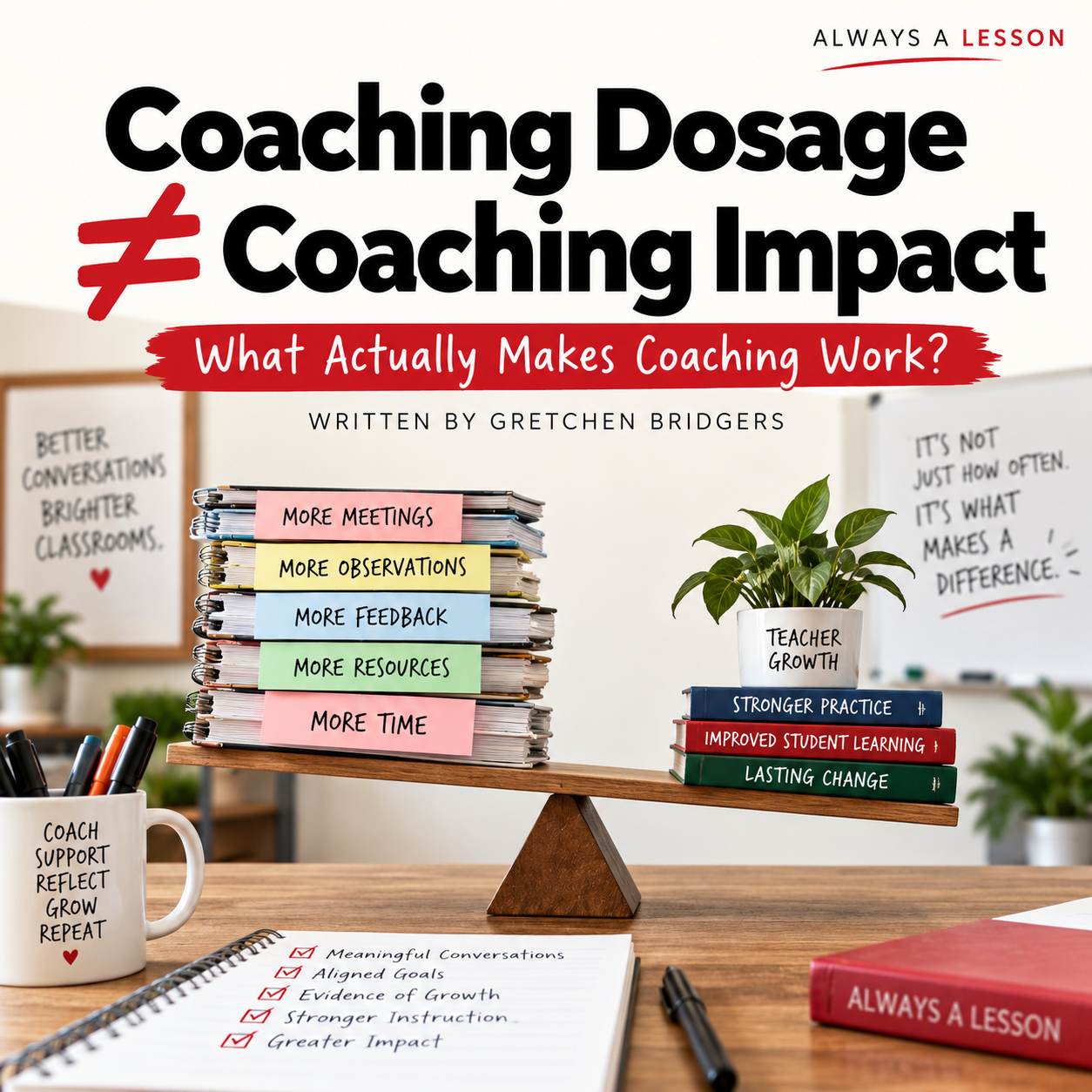
Many schools have an instructional coach on staff to support the growth and development of teacher instructional practice. But just because there is a coach does not mean there is a guaranteed positive coaching impact.
Schools often measure coaching by what is easiest to count.
-
-
- How many teachers did the coach meet with?
- Coaching cycles were completed?
- Hours spent in classrooms?
- Did the coach check in?
-
Those numbers can tell us something about access and activity. But they do not necessarily tell us whether the coaching is working.
A recent study of Michigan’s statewide early-literacy coaching initiative reinforces an important distinction for schools and instructional leaders: Coaching dosage is not the same as coaching impact. Researchers analyzed 1,330 coaching logs, 171 hours of video, interviews with 16 coaches, and data from 48 K–3 teachers. Teachers demonstrated greater instructional growth when coaching showed stronger fidelity to evidence-based content and used more intensive coaching processes.
In other words, the amount of coaching mattered less than a much more important question: “What was actually happening during the coaching?”
More Time Does Not Automatically Mean Better Coaching
There is a reasonable assumption behind increasing coaching time. If teachers receive more support, they should improve more. But coaching is not simply a matter of accumulating minutes.
A teacher might meet with a coach every week without making meaningful changes to instruction. Another teacher might experience fewer coaching interactions, but those interactions could be highly focused, evidence-based, and directly connected to what happens next in the classroom.
That means two teachers can technically receive the same “dosage” of coaching while experiencing very different levels of support.
One might receive:
- clear instructional feedback,
- opportunities to rehearse or plan,
- targeted modeling,
- analysis of student evidence, and
- intentional follow-up.
Another might spend the same amount of time:
- discussing a wide range of concerns,
- revisiting the same challenges,
- receiving broad suggestions, or
- having conversations that never translate into classroom action.
Both coaching relationships may look active on a calendar. Only one may be producing instructional movement. That is why schools have to be careful about confusing coaching activity with coaching effectiveness.
What the Research Suggests We Should Pay Attention To
The Michigan study points toward several factors that shaped coaching implementation: the quality and content of coaching, the coaching process itself, teacher receptivity, and coach caseload.
That matters because coaching does not happen in a vacuum. We cannot simply assign a coach, create a meeting schedule, and assume improvement will follow. Strong coaching requires attention to what coaches are helping teachers learn, how they are helping them learn it, and whether the school has created conditions that allow that work to go deep enough to matter.
This changes the question leaders should ask. The connecting thread of the following three questions will ensure quality of coaching produces the intended results.
- How much coaching are teachers receiving?
- What kind of coaching are teachers receiving?
- What is changing because of it?
A Better Way to Think About Coaching Evidence
One of the easiest traps in coaching is stopping too early when looking for evidence of success. A teacher says the coaching is helpful. The teacher attends meetings consistently. The relationship is positive. The coach and teacher enjoy working together. That all matters, but none of it, by itself, tells us whether instruction is improving.
I find it helpful to think about coaching evidence in three layers:
- Relationship- First, coaching needs trust.
- Does the teacher feel safe being honest about challenges?
- Does the teacher initiate conversations?
- Is the teacher willing to try something new?
- Can the coach and teacher disagree productively?
- Does the teacher see coaching as support rather than evaluation?
These are meaningful indicators. But relationship evidence tells us primarily that the coach has access to the work. It is not yet evidence of instructional impact.
2. Teacher Practice- The next layer asks a more difficult question: “What is the teacher doing differently because of the coaching?” Maybe the teacher is:
-
- asking stronger questions,
- checking for learning more intentionally,
- shifting more cognitive work to students,
- improving modeling,
- adjusting grouping,
- using evidence to respond during instruction, or
- implementing a strategy more consistently.
This is where coaching begins to move beyond conversation and into practice. The coaching does not have to create dramatic change overnight. But there should eventually be visible movement.
3. Student Learning- The third layer asks: “What changed for students after the teacher changed practice?” Student evidence might include:
-
- more students demonstrating understanding,
- stronger student reasoning,
- increased independence,
- higher-quality work,
- fewer persistent misconceptions,
- broader participation, or
- students being better able to explain what they are learning.
That does not mean every coaching cycle needs to produce a test-score increase. Student learning evidence can be much closer to the classroom than that. The important point is that we keep following the chain: Relationship → Teacher Practice → Student Learning.
Trust Opens the Door. It Cannot Be the Finish Line.
Relationships are foundational to coaching. A teacher is unlikely to take instructional risks with someone they do not trust. But trust is not the final outcome of coaching. Trust should create the conditions for professional learning. That learning should influence practice. And eventually, that change in practice should improve students’ experiences.
A simple coaching equation can help keep that progression visible:
- Trust opens the door.
- Practice shows movement.
- Student evidence shows impact.
Strong coaching looks for evidence across all three layers. Do not skip the relationship layer. But do not stop there either.
The Question Coaches Should Keep Asking
One question can dramatically strengthen a coaching cycle: “What changed because of the coaching?” Avoid asking yes or no questions like:
- Did we meet?
- Is the cycle complete?
- Does the teacher like the strategy?
- Did the coach provide support?
Asking “what changed?” naturally pushes the work toward evidence in areas such as teacher decision-making, instruction, what students were doing, saying, producing, or understanding. And if nothing changed, use that as evidence too. It tells us the coach may need to adjust the goal, the strategy, the support, or the coaching process itself.
What This Means for School Leaders
Leaders also need to reconsider how they evaluate their coaching programs. It is tempting to use metrics such as:
- teachers coached
- classroom visits
- coaching cycles,
- frequency of meetings, or
- percentage of staff receiving coaching.
Those numbers are useful for understanding reach. But they should not be mistaken for impact. A stronger coaching dashboard might include questions such as:
- Relationship
-
- Are teachers voluntarily engaging with coaching?
- Is trust increasing?
- Are teachers willing to surface authentic instructional challenges?
2. Teacher Practice
-
- What instructional practices are changing?
- Are changes becoming consistent?
- Can teachers explain why they are making those changes?
3. Student Learning
-
- What student evidence is changing?
- Are more students demonstrating understanding?
- Is student thinking becoming more visible?
- Are instructional changes solving the problem that prompted the coaching?
Now coaching data begins telling us something much more meaningful than how busy the coach has been.
Protect Coaches From Becoming Too Broad
The findings around coach caseload should also make leaders pay attention. A coach supporting too many teachers may technically provide coaching to more people. But greater reach can come at the cost of depth.
If coaches are constantly moving from teacher to teacher, they may have little time to:
- observe instruction carefully,
- analyze evidence,
- plan meaningful next steps,
- model or rehearse practices,
- return to see whether changes were implemented, and
- examine what happened for students.
That creates a difficult tradeoff. More teachers served does not automatically mean more teachers impacted. Sometimes stronger coaching requires narrowing the focus enough to actually follow the work from problem to practice to evidence.
A Reflection for Coaches
Think about one teacher you are currently supporting. Ask yourself:
- Relationship: What evidence tells me we have the trust needed to do meaningful work?
- Teacher Practice: What is this teacher doing differently because of our coaching?
- Student Learning: What evidence suggests that change is making a difference for students?
Then ask the hardest question: “Which layer has the weakest evidence right now?” That answer may tell you exactly where the next coaching impact conversation needs to go.
Coaching Impact Should Leave a Trail of Evidence
The goal is not to make coaching overly clinical or reduce every relationship to a data point. It is to make sure that the significant time schools invest in coaching leads somewhere.
A full coaching calendar does not necessarily mean instruction is improving. Frequent meetings do not guarantee changed practice. Strong relationships do not automatically guarantee stronger learning.
The work becomes more powerful when we stop asking only how much coaching happened and begin examining what the coaching changed.
Dosage tells us how much coaching occurred. Evidence tells us whether it made a difference. And that is the measure that ultimately matters when it comes to coaching impact.
Recommended Resources
If this post helped you think differently about instruction, here are a few ways to keep learning and put the ideas into practice:
- Always A Lesson: Teacher Essentials for Classroom and Career Success: Learn the foundations of high-quality instruction and the practices that help teachers strengthen both classroom impact and career longevity.
- The Instructional Leader’s Library: Lead the learning with ready-to-use professional development sessions, facilitation tools, coaching resources, and practical implementation supports.
- Teacher Leader Mastermind: Strengthen your leadership and coaching practice through a supportive virtual cohort focused on implementation, problem-solving, accountability, and impact.
GO BE GREAT!


About the author, Gretchen
I am a teacher trainer and coach. Working elbow to elbow with teachers and teacher leaders to ensure instructional proficiency and student achievement soar lights me up. We have a real need in our nation for strong educators to remain in the field. My blog, book, podcast, courses and instructional materials are geared towards empowering teachers (and those that lead them) to receive the support needed to grow and thrive today, tomorrow and always.