
The Instructional Coach’s Guide to Planning PD Without Losing Your Weekend
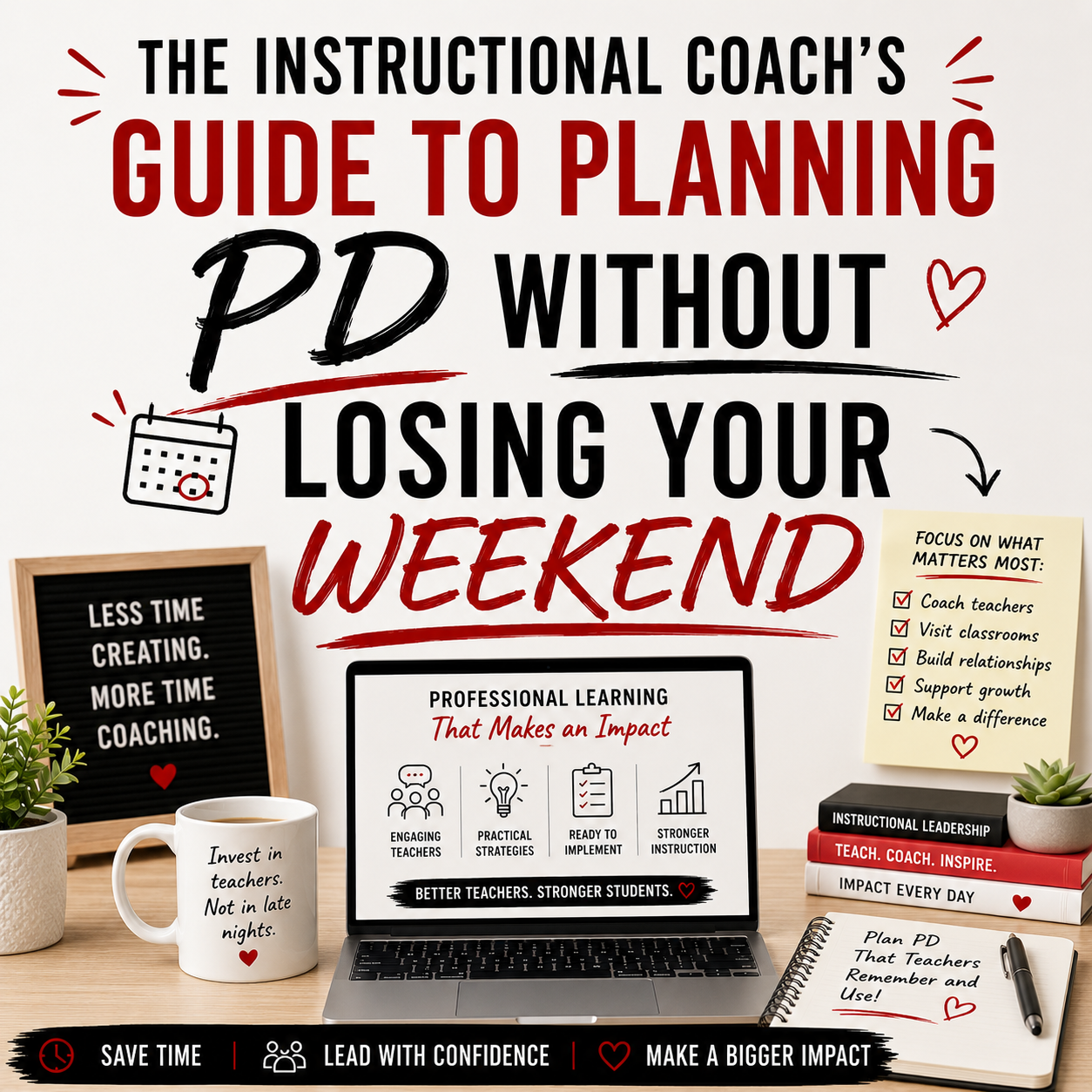
The truth is you didn’t become an instructional coach to spend your Saturdays making PowerPoint slides. Yet somehow…that’s exactly what happens.
It usually starts innocently enough.
“Can you lead PD next Thursday?” asks your Principal.
You reply: “Absolutely!”
Then reality sets in. You open a blank PowerPoint. You start searching Pinterest. You dig through old district folders. You borrow a slide here, an activity there. Suddenly it’s 10:47 p.m. on Wednesday night, you’re on your third cup of coffee, and you’re still wondering if teachers are going to roll their eyes.
If that sounds familiar, you’re not alone. I’ve been there more times than I’d like to admit.
Why PD Eats Up Your Weekend
Most instructional coaches don’t struggle because they lack ideas. They struggle because they start from zero every single time. Every new staff meeting becomes a brand-new project.
You have to decide:
- What should I teach?
- What order should it go in?
- How do I keep teachers engaged?
- What activities should they actually do?
- What handouts do I need?
- What should I say during each slide?
- How will I know if they actually learned anything?
That’s a lot of decisions. And every decision costs time.
The Hidden Cost of Creating Everything Yourself
It’s easy to think, “I’m just spending a few hours putting together this presentation.” But it’s rarely just a few hours.
It’s:
- Searching for research.
- Creating slides.
- Designing handouts.
- Building activities.
- Writing discussion questions.
- Planning reflection.
- Printing materials.
- Revising everything the night before.
One 60-minute PD session can easily require six to ten hours of preparation. Now multiply that by every staff meeting, PLC, beginning-of-year training, or coaching cycle you lead. No wonder instructional coaches feel overwhelmed.
What If You Didn’t Start With a Blank Screen?
Imagine a different workflow. Your principal asks you to lead professional learning. Instead of opening PowerPoint, you log into a resource library. You browse professionally designed sessions. You download one that matches your school’s needs. You personalize a few examples. Print the participant materials. Walk into the meeting prepared. That’s it.
Instead of spending your energy creating resources, you spend it thinking about your teachers. And that’s where your expertise actually matters.
Great Professional Learning Isn’t About Fancy Slides
One lesson I learned over the years is this: Teachers don’t leave talking about your slide transitions.
They leave talking about the conversation they had with a colleague. The strategy they’re excited to try tomorrow. The reflection that challenged their thinking. The action plan they created. That’s what changes practice.
Your goal isn’t to impress teachers. Your goal is to help them grow.
Protect Your Time So You Can Coach
Instructional coaching is so much bigger than leading staff meetings.
You need time to:
- Visit classrooms.
- Coach teachers one-on-one.
- Analyze student work.
- Meet with administrators.
- Plan coaching cycles.
- Build relationships.
When every free evening is spent creating the next PD session, those high-impact coaching opportunities suffer. The best instructional coaches aren’t necessarily the ones creating the most. They’re the ones spending the most time with teachers.
One Simple Shift
The biggest shift I ever made wasn’t becoming a better presenter. It was deciding I didn’t have to recreate professional learning every single time. That’s ultimately why I built the Instructional Leaders Library. Not because coaches need more resources. Because coaches need more time. Time to coach. Time to support teachers. Time to lead confidently instead of scrambling. If I can help instructional leaders spend less time creating and more time growing teachers, then I’ve accomplished exactly what I set out to do.
Final Thought
This weekend, ask yourself one question: Am I spending more time creating professional learning…or creating better teachers?
Those aren’t always the same thing. Sometimes the most impactful thing you can do is stop reinventing the wheel so you can focus on the people you’re there to serve.
GO BE GREAT!


About the author, Gretchen
I am a teacher trainer and coach. Working elbow to elbow with teachers and teacher leaders to ensure instructional proficiency and student achievement soar lights me up. We have a real need in our nation for strong educators to remain in the field. My blog, book, podcast, courses and instructional materials are geared towards empowering teachers (and those that lead them) to receive the support needed to grow and thrive today, tomorrow and always.