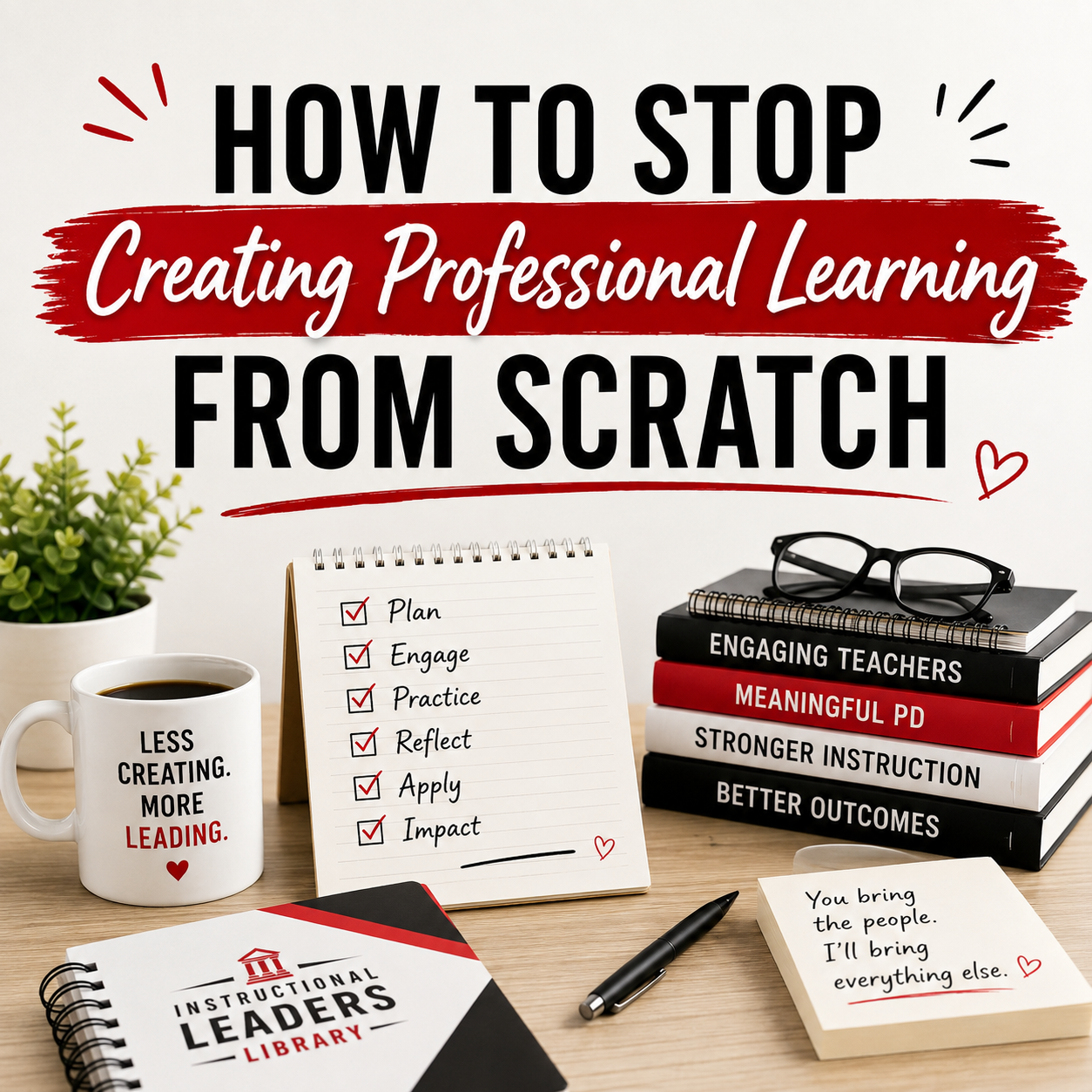
How to Stop Creating Professional Learning From Scratch
 Imagine this scenario: Your principal stops by your office and asks a seemingly simple question: “Can you lead professional learning next week?” You smile, say yes, and immediately begin calculating how many evenings it will take to pull everything together. You need a topic, slides, activities, participant handouts, discussion questions, facilitator notes, an action plan and maybe a follow-up tool, too.
Before long, one 60-minute professional learning session has turned into hours of work. This is a familiar cycle for instructional coaches, teacher leaders, curriculum specialists, and administrators. It is not because they lack good ideas or expertise. It is because transforming one idea into a complete, meaningful learning experience requires more than opening a blank PowerPoint. The good news is that you do not have to reinvent the entire process every time you are asked to lead.
Here is a practical framework you can use to simplify professional learning planning, protect your time, and create sessions that lead to meaningful teacher growth.
1. Start With the Teacher Need
It is tempting to begin by opening a presentation template or searching for activities. Instead, begin with the people in the room.
Ask yourself:
- What challenge are teachers currently facing?
- What do I notice in classrooms, coaching conversations, or student work?
- What skill or practice would make the biggest difference right now?
- Is this topic connected to a school goal or current priority?
The more specific the need, the easier it becomes to design useful professional learning. For example, “student engagement” is a broad topic where as “helping students participate in academic conversations” is much more focused. Another example would be “classroom management” which could go in many directions. “Creating consistent procedures for transitions” gives you a clear destination. Professional learning becomes more relevant when teachers can immediately connect the topic to a problem they are actively trying to solve.
2. Define the Change You Want to See
Once you identify the need, decide what should be different after the session. What should teachers know, understand, practice, or implement?
A common mistake is trying to cover too much information. A session packed with ideas may feel productive, but it can leave teachers unsure about what to do next. Instead, choose one clear outcome. For example, “by the end of this session, teachers will be able to identify one classroom procedure that needs strengthening and create a plan to reteach it. Or, “by the end of this session, teachers will be able to use a simple feedback framework to give students a specific next step.”
This outcome becomes the filter for every decision that follows. When considering a slide, story, activity, or handout, ask: Does this help teachers reach the intended outcome? If the answer is no, it probably does not belong in the session.
3. Plan What Participants Will Do
Professional learning should not be something teachers simply sit through. People are more likely to remember and apply learning when they have opportunities to think, talk, practice, reflect, and make decisions. As you plan, consider how participants will interact with the content.
They might:
- Analyze a classroom scenario
- Compare strong and weak examples
- Sort statements or strategies
- Discuss a prompt with a partner
- Examine student work
- Practice a coaching or instructional conversation
- Reflect on their current practice
- Create an action plan
These purposeful structures are what I call Learning Moves. Learning Moves are not activities added merely to make the session feel fun. They are intentional learning experiences that help participants process information, connect it to their work, and prepare to apply it. People may not remember what appeared on slide 27. They are much more likely to remember the moment they wrestled with an idea, heard a colleague’s perspective, solved a problem, or developed a strategy they could use the next day.
4. Prepare Yourself to Facilitate
A professional learning session is more than a collection of slides. Strong facilitation requires preparation for what happens between the slides.
Before the session, think through:
- How will you introduce the topic?
- What directions will participants need?
- How much time should each section take?
- What responses might you hear?
- What misconceptions could arise?
- What questions will help deepen the discussion?
- How will you transition between activities?
- What will you do if time runs short?
A simple facilitator guide can make an enormous difference. You do not need to script every word, but you should have enough support that you are not standing in front of the room wondering what to say next. When the agenda, talking points, timing, directions, and debrief questions are already planned, you can focus more fully on the people in front of you. You move from presenting information to facilitating learning.
5. Give Teachers Something Useful to Take With Them
Teachers do not need another packet that gets placed in a bag and forgotten. Participant materials should help them process the learning and take meaningful action.
A useful Learning Journal or participant resource might include:
- Space to capture key ideas
- Reflection questions
- Planning templates
- Strategy checklists
- Classroom application prompts
- An action plan
- A place to identify needed support
The goal is not to document everything that was presented. The goal is to help teachers answer: What does this mean for my practice? And, what will I do next? When teachers leave with a clear, realistic next step, professional learning is much more likely to influence what happens in classrooms.
6. Plan Beyond the Session
The end of the staff meeting should not be the end of the learning. Real growth happens when teachers have opportunities to try a strategy, receive support, reflect, and adjust.
Before the session ends, consider how you will follow up.
You might:
- Revisit the topic during a PLC
- Use a classroom look-for tool
- Offer coaching support
- Ask teachers to bring back student work
- Send a reflection prompt
- Conduct a brief check-in
- Celebrate early implementation
- Provide a related planning resource
This does not have to become another complicated initiative. Even a simple follow-up question can keep the learning alive. What have you tried since our session, and what are you noticing? When professional learning includes implementation and follow-up, it becomes part of an ongoing growth process instead of a one-time event.
A Simple Professional Learning Planning Checklist
Before your next session, ask:
Purpose
- What teacher need are we addressing?
- What change do I want to see after the session?
Learning Experience
- What do participants need to understand?
- What will they actively do?
- Where will they discuss, practice, or reflect?
Facilitation
- Do I have a clear agenda?
- Are my directions and talking points prepared?
- Have I planned the timing and debrief questions?
Application
- What will teachers leave ready to implement?
- Is there a clear action-planning opportunity?
- What follow-up support will be available?
This process can help you create stronger professional learning without adding more slides, activities, or information than teachers actually need.
You Do Not Have to Begin With a Blank PowerPoint
Even with a clear planning process, building a complete professional learning experience takes time. You still need to create the presentation, participant materials, activities, facilitator notes, coaching tools, reflection pages, and follow-up resources. That is exactly why I created the Instructional Leaders Library. I spent months developing every professional learning resource I wish I had possessed as an instructional coach.
Instead of spending hours creating a session from scratch, members can:
- Log in
- Select a professional learning topic
- Download the complete set of resources
- Customize anything they would like
- Walk into the room ready to lead
Each topic is designed as a complete professional learning experience, with resources such as editable presentation slides, facilitator support, Learning Journals, Learning Moves, coaching tools, printables, reflection opportunities, and action-planning resources. The Library does not replace your experience or expertise. It gives you a strong starting point so your time can be spent thinking about your teachers, adapting the learning to their needs, and leading with confidence.
Spend Less Time Creating and More Time Leading
Instructional leaders should not have to sacrifice evenings and weekends every time they are asked to lead professional learning. Whether you use the framework in this article to create your own sessions or begin with a ready-to-use experience, the goal is the same: Create professional learning that is purposeful, engaging, practical, and connected to teacher growth.
Your expertise is too valuable to spend recreating resources that could already be prepared. Spend less time staring at a blank PowerPoint. Spend more time coaching, supporting, and leading.
Explore the Instructional Leaders Library and discover ready-to-use professional learning designed to help you save time, lead with confidence, and make a bigger impact.
GO BE GREAT!


About the author, Gretchen
I am a teacher trainer and coach. Working elbow to elbow with teachers and teacher leaders to ensure instructional proficiency and student achievement soar lights me up. We have a real need in our nation for strong educators to remain in the field. My blog, book, podcast, courses and instructional materials are geared towards empowering teachers (and those that lead them) to receive the support needed to grow and thrive today, tomorrow and always.